Lostman's Star
Not all those who wander are lost, but I certainly am!
The Catacombs of St. Callixtus
First of all let me be very honest with you guys; this is one place that I want to go back to, if only because my memory of it is so vague. I’ll do my best to write down what I recall, but I will be filling in the gaps with a little research.
Like any major city, Rome needed a place for her citizens to rest when their soul left the world. In ancient times the culture dictated that bodies were to be cremated, but as time wore on burial became more and more popular. The Catacombs of St. Callixtus were dug out for just such a purpose.
It was once the resting place of the elite. Saints, popes, and wealthy Christians were at one time the only ones to be buried there, however the land was eventually donated to the church so that any Christian, rich or poor, might be given their proper burial within St. Callixtus.
I don’t remember any of this. Not the decorations, anyway.
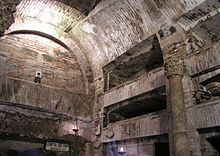
What I remember are, according to my research, likely the tombs of the ordinary Christians. I remember walking down halls, too tall for me but not nearly tall enough for my Dad or for Grandpa Lostman, both of whom stand over six feet. I remember rough hewn, rectangular holes carved into the stones, only on one side for some reason, though pictures show me that there were spaces for bodies on both sides. The lights cast an orange glow over the stone, and I remember being terrified that they would suddenly go out. This was likely because the tour guide had informed us that for one, becoming lost in the catacombs was very easy, and for another, our tour was the last of the day which meant that the lights would be shut off as soon as we left. I apparently had no intentions of falling behind, because Dad told me that I had abandoned him and Grandpa Lostman to follow the tour guide as closely as I could.
The fact that the lights were about to be turned off is one of only two things I remember being told on that tour.
The second concerned a statue, one which I liked the moment I saw it. It was of a beautiful woman, lying on the ground with her head turned away from the viewer. I noted that her neck had been slashed open, and the tour guide explained that the executioner hadn’t managed to cut her head off properly, and that she’d lived on and suffered for a while because of it. On hearing that I felt very sorry for her. I know now that this was a replica of a work by Stefano Maderno depicting St. Cecilia, a patron saint of musicians who was martyred and, so the story goes, lived for three days, carrying her head about in her arms.
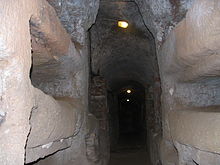
Another very vivid memory I have is a sense of guilt that came creeping into my heart as I wandered. I thought I should have liked it more, felt more at home, or somehow more loving towards the place that Grandpa Lostman and Dad called the resting place of my ancestors. Family was and still is very important to me, but I couldn’t picture anyone I was connected to resting there. I still can’t. One day I would like to go back, to see if that feeling has changed, and of course to visit Cecilia!
If you are looking for relics, or for bones stacked beautifully but irreverently like the ones in the Parisian Catacombs, this is not the place for you. The people who once rested at St. Callixtus have been gone for centuries, removed to create relics for churches or else made dust by the passage of time. That said if architecture, the burial of saints and popes, or general history is your thing, then it’s well worth the visit for you.
I recommend it to everyone irregardless. There’s something about St. Callixtus which lingers with you. It’s been over a decade, and though my memories have faded I can still remember the roughness of the walls beneath my fingertips, and sadness which filled me upon learning Cecilia’s story. The catacombs will undoubtedly leave a lasting impression upon each of it’s visitors; what that impression is, you’ll have to visit to find out.
 Lostman's Star