Lostman's Star
Not all those who wander are lost, but I certainly am!
The Giant’s Causeway

There are two stories which tell of the Giant’s Causeway, one, to my mind, being far more interesting than the other.
The first is that the octagonal rock formations were caused by a volcano. They happen when magma chambers cool very slowly, forming octagonal pillars of stone which are then revealed when the volcano cone has been eroded away.

Irish legend stipulates that a giant named Fionn Mac Cumhaill (Finn McCool) tore stone from the shores to build this causeway so that he could take on a Scottish giant, Benandonner, who was threatening Ireland. Unfortunately Fionn realised that Benandonner was much, much bigger than he was, and so Fionn ran back to Ireland and at the suggestion of his wife, disguised himself as a baby. When Benandonner beheld Fionn in his disguise, he grew fearful. If this was a baby, how big was the giant who fathered him!? Benandonner then fled back across the causeway to Scotland, tearing it up as he went. Benandonner’s half of the causeway is known to us today as Fingal’s Cave.
Depending on where you intend to stay during your visit to the island, you can find tours to the Giant’s Causeway which leave from Dublin in Ireland, or from Belfast in Northern Ireland. Personally I took a tour both times from Dublin, and although the trip was long I found it to be worth it.
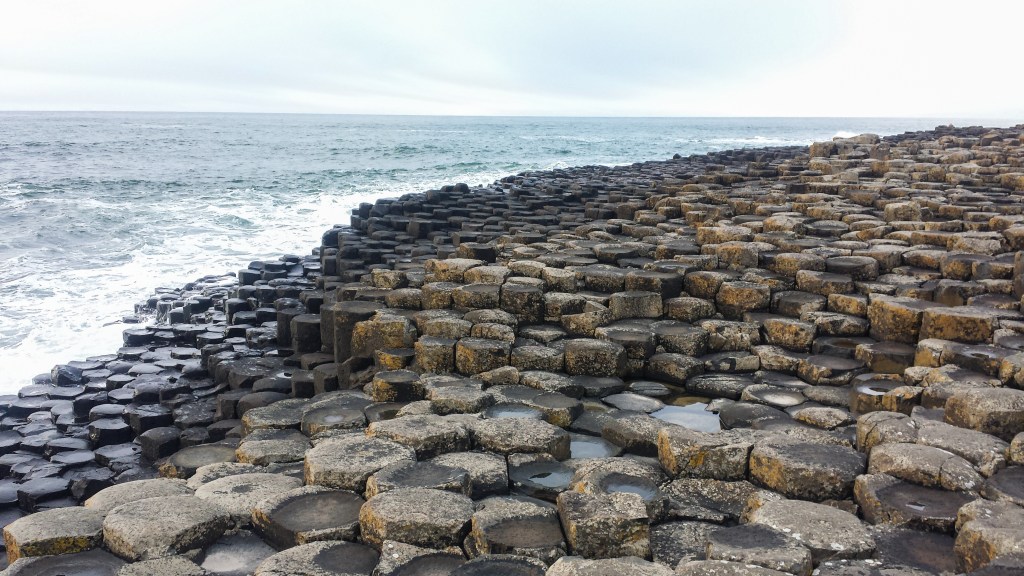
There’s something about the Giant’s Causeway which draws one to it. Whether it’s a sense of mystery as to how the rocks were formed or just the innate majesty of the sea crashing upon the rocks, I couldn’t say. All I can say is that should anyone invite me for a third time to visit this particular lieu I wouldn’t lightly refuse.
Whether you’ve driven yourself or taken a tour, you’ll end up in the parking lot just outside the visitor’s center. You’ve got a few options once you’re here. The first option is a local pub where you can enjoy the view and a pint, though you’ll not see the causeway itself from there. The second option is to go to the visitor’s center. This, to my mind, is needlessly expensive, and is not recommended by any of the tour guides I’ve been with. Due to Covid if you do choose to go in you should book your ticket a few days in advance on the National Trust website. Your third options are to go down to see the causeway itself, which is likely what you’ve come for. This is free, though if you have a few pounds there is a bus which leaves every fifteen minutes and takes you down to the causeway and back up to the car park. It’s a bit of a hike, so while the walk down might be something you’d enjoy, I doubt the walk back up to the carpark will be. Should you decide to ride the bus you’ll be given the choice of paying twice, the price of which I believe is £2.50, or £4 for a round trip. Remember that you’re in Northern Ireland and they use pound sterling rather than Euro like the rest of Ireland.

At the Causeway there is a lot of area to explore, and a lot of people wanting to explore it. Be careful, the rocks will likely be slippery. Wear good running shoes, and be kind and considerate of those around you. The regular rules apply, leave only footprints, and take only photos. Bring a camera because be it sunny or blustery, the scenery is spectacular.
Wash your hands, wear a mask, and stay safe gentle reader.
 Lostman's Star