Lostman's Star
Not all those who wander are lost, but I certainly am!
Let’s Get Rid of Pay-Toilets Please!
I had the inspiration for this article while I was writing last Friday’s destination piece about Camden Market. Check it out if you haven’t already, it’s a little guide to one of my favourite places on earth. I love the shops, the products, the food, the people, nearly everything about it is great. There’s just one not-so-tiny flaw that really gets my hackles up about the place. Some of the bathrooms are paid bathrooms, and I hate that.
I have mostly encountered these kinds of washrooms in England, Mexico, and Italy, and essentially they’re toilets that you need to pay to use. Ask anyone who has ever heard of them and they’ll tell you that your money is a contribution which helps keep the bathroom clean and well maintained. The going-rate, if you will, can range anywhere from 10 cents to a full dollar of whatever currency the country uses. As far as I’ve seen there are three varieties of washroom.

The first type of bathroom is usually attended by one of the cleaning staff members, and has a little bowl or tray into which you can put your money. It is polite to pay and you do seem like a bit of a mean-spirited person if you don’t, but you’re by no means forced to put any money whatsoever into that tray. I have no problem with these. In fact these aren’t so much paid bathrooms as they are donation bathrooms.
The second also has an attendant, and when you give them the money they give you some toilet paper to use. The third type has turnstile gates at the entrance, so that unless one has mastered the art of parkour, you won’t be able to get in without paying. This article, and my burning ire, is directed at these bathrooms.
Let me be clear that while Camden Market has inspired this piece, they do have bathrooms on the lower levels that are free and they are by no means the only offender. King’s Cross, Nymphenburg Palace, Neuschwanstein, Brighton Train Station, and even the City of London have ‘public’ washrooms which require you to pay. I have a bone to pick with these and every other paid bathroom in existence, so Camden Market is merely a singular skirmish upon my dragon hoard of battles to fight.
If I had a nickel for every battle in my lifetime I would be a billionaire, but I digress.
You might be thinking; “Look, Lost, if you can afford to travel all around the world would it seriously kill you to pay to use the toilet?” No, it would not. In an emergency I will use them and you should too. When you gotta go you gotta go!
That’s the problem. These paid bathrooms are in essence a shakedown. You can pay, walk away, or ruin your day. The philosophy behind my hatred of them is very simple:
Nobody should ever be put into the position of having to soil themselves because they don’t have money.

That’s it. That’s seriously, 100% it. Every living cell on the planet has a process by which they get rid of waste, but someone decided that the poor don’t have a right to it because they can’t be profited from. It’s disgusting.
Don’t get me wrong, I hate these bathrooms for numerous other reasons, but on the sole basis of their affront to human dignity they should have been made illegal decades ago.
I hear you, though. We aren’t all saints, and I’m certainly not one myself. So, if you will allow, let me bring a monetary argument into the equation.
I don’t think most of the money pay-toilets make goes into the maintenance of the bathroom, or towards paying cleaning staff, and you are therefore paying for literally nothing.
I haven’t spoken to any paid-toilet staff about their wages, nor have I riffled through any bathroom-business-owner’s accounting books so I have no hard proof to suggest that the above statement is true, but what I do have are the following personal experiences. They, and others have led me to believe that it is likely true for most pay-toilets I have encountered.

When I was in Germany with Forest we went to a restaurant and found that the bathroom inside was a donation toilet. I had assumed that it would be free for the patrons of the restaurant, so I had left my wallet with Forest. When I didn’t pay anything for the first visit the attendant looked a bit put out but said nothing. When I went in again later I brought a couple of coins with me, over and above the ‘asking price’ of my visits. It was my way of saying “Sorry for earlier, I didn’t know.” The attendant thanked me with a hug. Why hug someone for a few extra coins if you’re making a livable wage?
As for the maintenance of the bathroom, most free public washrooms are decent. Donation bathrooms can be a bit of a toss up, but the one in Germany was spotless. So how is it that every single pay-toilet I’ve ever had the misfortune of stepping into has been substandard at best? It’s unacceptable. They are always filthy, the hand driers only work on days starting with a T, the toilets may or may not flush, there’s never enough soap or paper towel, and the sinks run so cold that I half expect a clay penguin to pop out and start honking at me. Noot noot!
If I’m expected to contribute, then in turn I expect service delivery!
It never is though, and I find it so baffling that someone could decide to build a public washroom, make it immediately inaccessible to those who cannot be profited from, stock it with as few supplies as they could get away with, pay the staff who clean it the bare legal minimum, let it get to the point where it is barely sanitary or even functional, continue to demand that you pay over and above these expenses, then top it all off with a piece of propaganda saying that all of this is for your benefit.
The system simply doesn’t work.
There is good news, though, if only a little bit. While writing this I came across an initiative within the borough of Camden which pays businesses to let people use their bathrooms without purchasing goods or services. The best part is that businesses are finding that the people who use their washrooms freely are coming back as customers. I had also noticed upon the last couple of visits I made to King’s Cross that the change maker for the bathroom was out of order and so people were allowed to go in freely. It’s not a place I visited regularly, so I don’t know whether there was lack of willingness to repair the machine or a conscious effort to keep breaking it.
I’m sure there is some sort of legislation that could be passed to make pay-toilets illegal, but until such time, I have a little message to King’s Cross:
If that ‘out of order’ sign never gets taken down, I think we’d all be just fine with that.
Camden Market
If you’ve seen Peaky Blinders, you have some inkling of what Camden Market is like. On the outside, the dockyards and warehouses look fairly similar to those my favourite character, Alfie Solomon, uses as his … bakery … Is his name Solomon or Solomons? This needs to be settled! On the inside, though, the market is far more fabulous than any warehouse. Sorry, Alfie!

The market itself is actually an old equine hospital, the stalls having been converted into miles upon miles of twisting, turning stores. It’s so unique and so labyrinthian that it took me several visits to see the whole thing. There’s also a little trick to finding Camden Market, one that luckily I had known about (research!) before I went.
I always came up from the south, so when visiting Camden I took a train into London and then the Tube. The closest stop is Camden Town on the Northern Line, which pops out just a couple of blocks from the market.
Here’s the trick. There are a lot of of markets around there claiming to be Camden Market. You could even be forgiven for thinking that the market is just all of Camden High Street. It’s festive, and high spirited, and it should not be ignored, but my advice would be to get to the real Camden Market first. It’s the main show!
When you pop out of the Tube onto the High Street, go right. Cross to the other side of the street now if you want to, you’ll have to do it eventually.
You will pass the Inverness Street Market, and the ‘Camden Market’ which is proudly painted on a green sign. Keep walking. These are not the stalls you’re looking for. Keep walking until you cross a bridge, and the real Camden Market is on your immediate left. If you’ve passed under the rail-bridge that says Camden Lock on it, you’ve gone too far.

Have a good look around, most of the vendors are locals, and sell high quality products that they have handcrafted themselves. You can find everything from clothing, jewelry, woodworking, soaps, tea, furniture; I even purchased two gorgeous paintings there for my Mom, it’s really and truly a wonderful place. When it comes time to finding something to eat, let your nose guide you. There’s an Asian section, lots of little stalls right near the entrance of the market, and a couple of restaurants interspersed in between and across the lock. There’s something for every taste, and yes, there are chocolate and ice-cream places for those of us who consider dessert to be a meal on it’s own. No judgment!
There is just one thing about this place that saddens me.
You need to pay to use the washroom.
I hate it so much I wrote an entirely separate article about it called Let’s Get Rid of Pay-Toilets Please! It’ll be posted the Tuesday after this is published. Click the link to check it out!
Either head to the lower level where the stables are for the free bathrooms, or keep a few coins in your wallet for this, and other such occasions because Europe is full of paid bathrooms. The only semi-acceptable thing about that Camden Market bathroom is that you can use a card to pay for your entry.
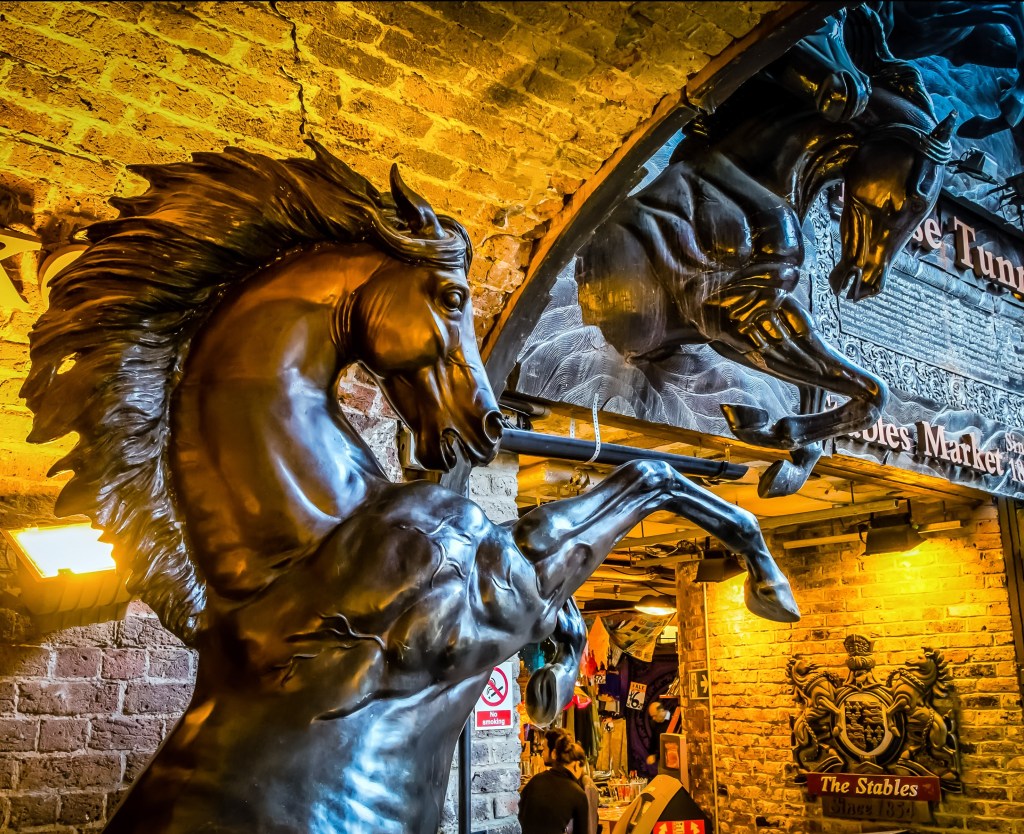
Other than that, the Camden Market is one of my favourite places on the planet. It’s so lively, unique, and it’s the perfect place to get lost for an afternoon, even if you don’t purchase anything but food.
Let me know in the comments if there are any markets that you love and think everyone should visit!
Introducing … The Tulips!
This story starts in the Netherlands, when I discovered that tulips are kind of weirdly awesome.
Yeah, I know, but hear me out!
The original tulips come from the mountains and steppes of the Middle East, and were gathered and bred to fill the royal palaces in the spring. The Seljuk Turks in particular were very fond of them and held many a lavish party to view them. The giant hats worn by the Ottomans that everyone compares to an onion is actually meant to mimic a tulip, and many Muslims consider them to be a symbol of Allah, because of the similar spelling in the Arabic alphabet. It wasn’t until much later that the tulip made it’s way to Europe where the Dutch developed a mania for them. It got so insane that at one point a singular bulb of a rare species could be worth as much as a house! Of course, what goes up must come down, and the economy that soared on a tulip high collapsed in a traumatic way when some of the bulbs didn’t show up for inspection before an auction. It was the first stock market crash!

The economy of the Netherlands isn’t so dependent on tulips now, but I would be hard-pressed to say that they don’t have a significant part to play. With all the tourism they bring in, and the sales of the bulbs themselves, I can’t help but think they make the Dutch government a fair chunk of change. Of course, I didn’t know any of this when I first visited the Netherlands. The most I knew was that they seemed to pop up around Easter, and that Canada received a gift of tulips from Holland every year as a thank you for the country’s part in their liberation from the Nazis. I’m not talking about a bouquet, either. They send us 20,000 bulbs! 10,000 from the Dutch Royal Family, and 10,000 from the people of the Netherlands. They get planted in Ottawa every year, and they are quite the sight to behold!
In the Netherlands the place to see tulips is the Keukenhof Gardens, which my Aunt River and I went to see in 2019. We each bought some bulbs and had them delivered to Canada in September. I purchased twelve bulbs of four species: Red Impressions, World Peace, Queen of the Night, and White Triumphator.

Red Impressions were, what I was told, what would be the closest to the original red tulips found in the Turkish royal palaces. I bought them along with World Peace in the hopes that they would naturalize, so that I could give them as gifts, though I hope all of the tulips naturalize! The Queen of the Nights, well those I just had to have. They bloom black! The White Triumphators I bought as a gift for Mom. She loves all things frilly and girly.
Aunt River, being not only the art connoisseur of the family but also the gardening expert, told my Mom and I how to plant them when they arrived. They needed to be in holes dug between eight to twelve inches deep, with a handful of chicken manure fertilizer at the bottom, then the tulip bulb, then another handful of of fertilizer on top before packing the dirt back on top of them.
All that happened this fall, so for now all I can do is wait for the thaw. I’m excited to see them!
Mont-Saint-Michel
As the name may have suggested to you, Mont-Saint-Michel can be found in Normandy, France. Specifically, it’s located in the estuary at the mouth of the Couesnon River, the nearest town being Avranches. If you’re seeking to travel somewhere that looks like it was pulled directly out of C.S. Lewis’ Narnia novels, then Mont-Saint-Michel is just the place. Reminiscent of Cair Paravel, this enchanting tidal island is a wonder not only of construction but of beauty.

It was constructed, so the story goes, when St. Michael the archangel appeared to a bishop, and told him that he should build a church upon the hill in the estuary. Obviously, he did just that, but the truth of the matter is that the hill was in use long before any bishop came along. It was a humble monk, one from Ireland, who founded the original site. It grew with the coming of the Romans, Francs, Vikings, and all sorts of other cultures until it was molded into the abbey that is seen today.
Now the island is ‘owned’ by various shop keepers and restaurateurs, and the small populace who live on the island all year round. Monks who were chased out during the French Revolution have returned in small numbers as well. I believe when I visited there may have been eight or twelve of them currently living in the abbey.

Arrow and I happened to go on a tour where lunch was provided at a lovely restaurant off the island. It provided a panoramic view from the dining room of the island, and it’s a good chance to meet your fellow travelers, and share some stories. You can then either walk the bridge or take a bus for a couple of euro to the island. I would recommend the bus, so that you have more time to spend on the island itself. We were given a tour of the abbey with a guide, but we were also given time to explore on our own. Give the abbey a thorough look-over, but don’t neglect the other aspects of the island. There are not only other churches and cute shops to visit, but higher up in the abbey there are spectacular views of the estuary on all sides.
It is a lot of climbing, but it’s not for nothing! There is beauty all over the island if you’re willing to work for it.

Are there any other tidal-islands that you love? Let me know in the comments!
The Heart Attack in Brussels Centraal Train Station
Night was making it’s slow, stead ascent into the town of Brussels; the last light from the sun mere slivers upon the edges of the tallest buildings. The blue dusk gave the town a sort of fairy tale glow and I couldn’t help but be saddened that I would only be able to see a small part of it.
Aunt River and I had just disembarked from the first of three train rides we were to take that bittersweet day. We had bid a fond farewell to Amsterdam and to Paris three days before that and were returning to my home in England.
We figured we had about an hour and a half to grab some food before our next train, so we made our way to the food court. Brussels Central was mostly closed for the night with the exception of a couple of fast food restaurants to cater to late travelers such as ourselves. I recall saying to Aunt River that we should eat, but keep a close eye on the time. The next train to London after ours departed in the morning. I didn’t fancy sleeping on a bench on the platform, and I can safely assume that neither did Aunt River.
We sat, ate, watched those few people around us come and go, and planned our next step. We didn’t know where our platform was, so once we finished dinner that was going to be our objective. Once we found it, we would be home free. I was already familiar with St. Pancras Station, and from there I knew my way home by heart.
When we finished our meal, we checked the time.
It was Panic O’Clock.
We had about fifteen minutes to find our platform and catch our train.
We scooped up our things and headed back towards the platforms. The sign for ours seemed to point towards a closed door, and an elevator. We chose the elevator.
Upstairs we found no sign of what we were looking for, but we did find one man standing behind a row of counters. He told us we would have to go back downstairs.
We came back down. Twelve minutes to go.
We wandered around the hall looking for a sign that didn’t say closed, all the while our panic and frustration was rising because where in the of Heaven could that sign be pointing to – until finally we strayed close enough to the closed door.
It opened automatically.
That beautifully infuriating glass door, with it’s frosted horizontal stripes and lovely decorative teapot printed on it, which looked more like a closed up tea-shop than anything remotely resembling a train platform, slid smoothly open to welcome us … to security?!
How? How could I possibly have forgotten about customs and security?
Aunt River had an excuse, she hadn’t traveled as much as I had in the past two years, but I had been in airport after airport, and the same principle applied. Even though I lived in England I still had a Canadian passport. I couldn’t just hop gleefully from one country to another like everyone else in the European Union, nor could I pass in and out of secure areas as I pleased.
We hurried forward and handed our tickets to the security attendant, who with widening eyes said “You are very late! What are you doing?! Go!”
We gave our passports to the customs agents who looked at us with cold, unfeeling eyes. Questions were asked and monosyllabic answers were given.
We collected our papers and hurried once more, this time to security. Let it be known that I have been in lines for security that easily held one hundred people or more. None of them ever felt as slow-moving as this one.
Did we have coins in our pockets? Did we have anything dangerous? We needed to take off our shoes, because of course we did.
Aunt River and I agreed, while our bags were being scanned, that although the seat numbers are posted on the outside of the train cars we would simply run into whichever compartment was in front of us. If they wanted to give us trouble for getting into the wrong compartment they could do it while we were already on the train.
Our passports were stamped. We were scanned. Our baggage was checked.
Three minutes to go.
We ran.
Not that weird adult trot we all do when we’re running across a street whose light is about to change. No, we were booking it like little kids playing tag with their older, faster siblings.
We even ran up the escalator, my suitcase never seeming so light to me as it had then.
The attendant on the platform, likely noting our red faces and huffing breaths, waved at us to come over to him. “Don’t worry about the seats,” he said, his voice holding all the calm that I did not feel. “The train is almost empty. Just sit wherever.”
We boarded, out of breath yet suddenly bursting with laughter. I checked the time.
Forty seconds to spare.
We hadn’t even sat down by the time the train started moving.
Mainly, I attribute our luck to my habit of checking the time frequently, and to the fact that both Aunt River and I are bilingual. We can’t even recall whether or not we were being spoken to in English or French, all we know is that we understood what was being said to us. I pity those who don’t speak either of those languages and who find themselves in a similar circumstance.
Despite this one moment, I can vouch for train travel as the most relaxed method I’ve used to get from one location to another. You can ride in comfort and peace, letting the scenery roll by while you read a book or chat with your travel buddy. There’s significantly less stress than going by plane or boat.
That said, be on time, or pray that God have mercy on your rushing soul for it is insignificant to a train on a schedule!
The Pyramid of Kukulkan
Given that I was nine at the time of my visit I didn’t learn much of Chichen Itza’s history, nor did I truly care to learn. I have never been fond of hot destinations and I was content to hide in what meager shade I could find until my parents dragged me up the Pyramid of Kukulcan. I’m glad they did, for one because tourists aren’t allowed to climb it anymore, and for another because standing on top of that temple is one of the most vivid memories I have.

It’s been well over a decade since I was there, but I can still feel the heat on my skin, see the endless jungle, and feel the sense of unearthliness about it all. Somehow, standing on top of that pyramid gave me the sensation that this was as far from home as it was possible to be. It’s easy to feel like a stranger there.
If you go during the spring or autumn equinox you can see ‘the descent of Kukulkan’, the feathered serpent on the side of the pyramid. Thousands of people visit it during this time, so be prepared for a crowd. If that isn’t your thing, you can still see an albeit skewed version of Kukulkan on most days as he slithers his way down his pyramid. It’s a wonder of mathematical, astrological, and human ingenuity, so if you truly want to appreciate the pyramid, do a bit of reading up on it before you go.

There are other features of Chich’en Itza that shouldn’t be ignored, including the Temple of the Warriors, cenotes (sink holes), and the Great Ballcourt. Each piece of architecture has it’s own story to share, but if you only have time to see one thing, go see, and marvel, at the Pyramid of Kukulkan.
Have you ever been to a place where you felt like a complete stranger? Leave a comment!
5 Things I Learned About Cruises While On One
I’ve only ever been on one cruise, but it was a really cool experience. I would definitely go again, but there are a few things I’ll be sure to take into account this time.

#1: You will feel the boat rock.
For most of my life I have been prone to motion sickness, but thankfully it isn’t as bad now as it used to be. When I was a teen I would get bad cases of vertigo. I still do, just much less frequently. For those of you who don’t know what vertigo is like …
SCIENCE BREAK!
Dizziness is what happens when your ears (your balance center) and eyes are sending messages to your brain, but the messages don’t match. Your ears, along with all your other senses are saying “We’re being still!” but your eyes say “We’re moving!” Your brain doesn’t like that, so you feel dizzy. Motion sickness is the opposite, where your ears say “We’re moving!” but your eyes say “Nonsense, we’re staying still!”

Vertigo is like motion sickness on steroids. Your ears are having a panic attack and your eyes are a set of cautious hypochondriacs. When you have your eyes open during an episode of vertigo, your ears are screaming that you’re being flung through time and space while your eyes get confused and say “Well… we’re not being flung anywhere, but the room does seem to be doing something funky.” For me, the room starts to ‘spin’. It does quarter turns and resets itself every second or so. If you close your eyes, your brain ‘loses’ one of the senses reassuring it that you aren’t, in fact, about to be hurled into the sun. All it can do is listen to your panicking ears, and to me it feels like my head is being whipped from side to side like windshield wipers set on maximum overdrive.

Motion sickness never caused vertigo for me, but having both at the same time was never fun.
SCIENCE BREAK OVER!
I didn’t know any of this when we booked the cruise, I just knew I became motion sick fairly easily. I asked my parents if I shouldn’t bring some Gravol, or get something to help with the motion sickness. Mom was adamant that I wouldn’t be able to feel the ship rocking beneath me. My sensitive balance centers would be fine.

She was wrong. Just straight up wrong. “Mother doesn’t always know best,” was a lesson I learned the hard way.
Thankfully we had calm seas throughout the cruise, and being distracted helped, so during the day it wasn’t noticeable. Trying to sleep was a completely different story. With no distractions, low visibility, vertigo, and the rocking of the ship, falling asleep was no easy task.
All this to say you will very much regret not bringing motion sickness medicine with you should you find yourself in need. Just. Bring. It.
#2: Buy what you want before you board the ship.
Upon boarding our cruise, my parents noticed that there was a little duty free shop just before the gangway section where you could purchase odds and ends before getting on your cruise. When we got to the cabin, my parents decided that they were going to go back to that store to get some baileys for their morning coffee, and some bottled water for days when we would be exploring the port cities. They were absolutely correct to do so, everything on the ship is more expensive, so it was a good way to save money and be prepared. That’s not why I’m telling you to buy things before you board, though.

My parents handed me my key to the cabin, and explained where they were going, and that they’d be back shortly. Being the excellent and perfect child that I am, I plopped myself down on the bed, dug out my book, and awaited their return. I expected them to be fifteen minutes, half an hour max.
Bing bong! Over the intercom came an announcement instructing all passengers to meet at one of several designated area for muster drill. Essentially a roll call and a security briefing. I grab my key and go, thinking that my parents would have heard the announcement and made their way there.
I waited for over an hour, heard the security briefing, gave my name and theirs, only for them to not turn up. Between telling myself that everything was fine, and that they were probably just at another meeting area my anxious mind kept wondering “What if we sail without them?!”

When the briefing was over I went back to the room, thinking that they would be there for sure. They were not. It took them another half an hour to show up, at which point I not so politely asked them where they had been. Alright, so maybe I’m not a perfect child.
It turns out that one cannot leave or board the ship while the muster is being performed. My parents had managed to disembark and get to the ship before the announcement came, so when they tried to re-board they were told they would have to wait on the dock until it was over. I was told that was a bit of an ‘uh oh’ moment.
Today we laugh about it, but at the time I was far from amused. The moral of the story, save your loved ones a heart attack and just buy what you want before you board the ship.
#3: The stores on the ship close when you’re in port.
When the ship docks, that’s your cue to get out and go exploring. We came back to the ship early one day and none of the shops were open. There was exactly nothing to do on the ship except swim or lounge, which we could have been doing on one of the beaches. Purchase an expedition, or go have a wander around the port. Everything there will be open to take advantage of your cruise ship’s business.

#4: Bring Extra Swimsuits and Books.
It’s uncomfortable having to shimmy into a bathing suit in the afternoon when it’s still wet from that morning’s swim. An easy solution is to bring more than one. I usually find my swimsuits are suitably dry after one day, so depending on how much swimming you intend to do, bring two or three!

Bring a couple of extra books, too, if you’re an avid reader or likely to spend a lot of time pool side. I was restricted to one book by my mother (again, she doesn’t always know best) and I finished it on day two of the seven day cruise. When I went to purchase another I found that I had a selection of one rotating rack, and two categories: harlequin romances, and murder mysteries.
Let’s just say they asked for some ID when I purchased my book. Either shop for your literature outside the ship, or bring an e-reader.
5: The boat won’t wait.*
If you’re not at the boat on time, you will miss it. You could be running up the dock at 10:01, if the cruise said it was leaving at 10, you are not getting on. The captain does not care why. All they care about is keeping to their schedule. You could be lost, in the hospital just finishing up getting stitches for a minor injury, being mugged in a dark ally, it does not matter, that boat will not stop and wait for you.
*Unless you have money.

I remember one evening we were supposed to have left at around dinner time, and I noticed that we’d had to wait about fifteen minutes longer to set sail than we otherwise would have. It wasn’t that it was a great inconvenience to me, and it didn’t interrupt any scheduled activities, it was just odd. I remember watching from the balcony as someone made their way up the gangplank. Shortly after, we set sail.
At dinner the rumours beginning to circulate. Apparently the captain had wanted to leave on time, but was convinced to wait for this particular passenger because they were fabulously wealthy. The reason they were late? They’d been out partying and lost track of time.
It was irritating to find out that one person had made upwards of three thousand people wait just because they thought the rules didn’t apply to them, and they turned out to be right.
If you’re rich, be on time, and show some respect to the people you’re traveling with. If you’re not, don’t be late. The boat won’t wait.
Are there any lessons you learned the hard way while travelling? I’m sure they make for interesting stories! Share them if you’re willing in the comments!
Clava Cairns
Way up in the highlands of Scotland, I was inspired to visit these monuments by my mother’s love of the book Outlander by Diana Gabaldon. In the first book, the protagonist, Claire, visits a place near the Battlefield of Culloden called Craigh na Dun. The inspiration for this stone circle was the Clava Cairns.
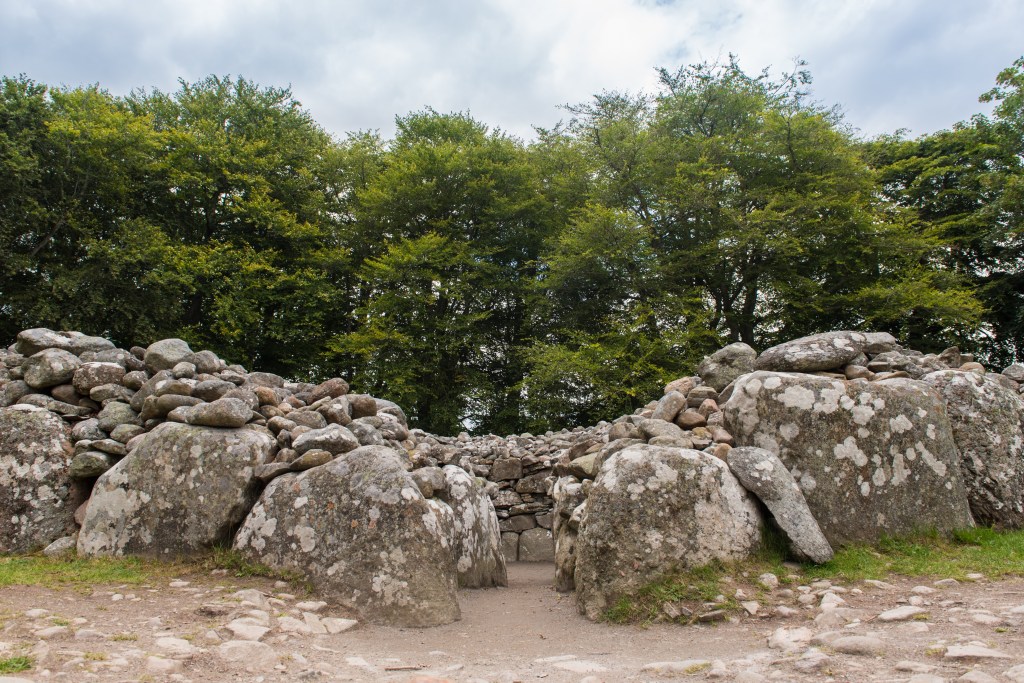
If you’ve ever played Skyrim, you’ll have some idea of what the word cairn entails. It means a burial place, which is exactly what the Clava Cairns are. Several of the four cairns had remains in them when archaeologists began studying them in earnest. These bones have been removed of course, and the area surrounding them has been walled off with a small stone fence. You can still go in of course and explore both the exterior and interior of these low walled cairns.
Of course, we have no idea if burial was the original intention of these stone circles, or if the bones were added long after their original purpose was forgotten. I’m no expert, but to me it seems like they were at the very least ceremonial in purpose, as they are quite similar to other passage tombs I’ve had the privilege of visiting. Deliberate notches in the stone are reminiscent of ancient constellations, and although Gabaldon didn’t know this when she wrote Outlander, there is a cleft stone in the middle of the park!
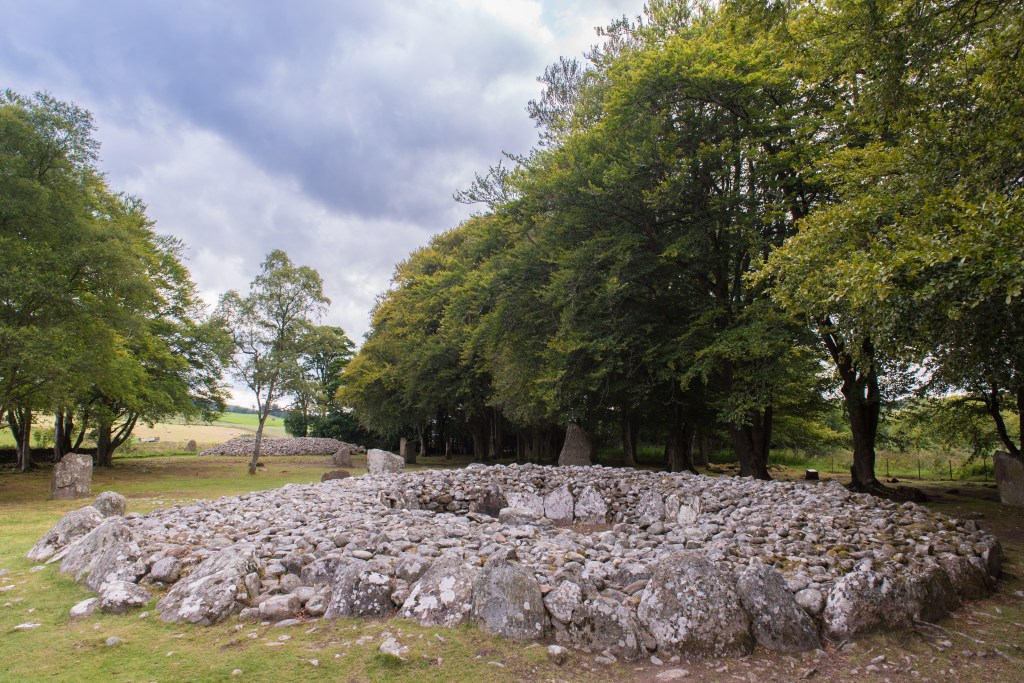
If you have a car you can drive right up to the park where they stand and see them for yourself. If not, tours of the Clava Cairns, Culloden, and the rest of the highlands leave from Inverness. It’s a public park, meaning there’s no entrance fee, and any time of day is a good time to visit, but I happen to visit just as the sun was setting, when the shadows were playing among the leaves of the trees. They’re great, massive things growing between the cairns, and the fading light certainly adds mystique to the area; not that it lacks any.
Are there any old, prehistoric dwellings that you know of? Let me know in the comments!
Mexican Rice
While this isn’t a recipe I had in Mexico, it is delicious, especially when served with guacamole and sour cream. The great thing about it is that you can substitute almost anything in this recipe, take things out, add it, and change it around to make it your own!
Ingredients
5 Avocados
2 Plum Tomatoes
2 Lemons
1 Red Onion
1 Pound of Ground Beef
2 Peppers (1 Red, 1 Yellow)
2 Carrots
1 (12 ounce) Can of Tomatoes
1 Can of Corn Nibblets
1 (15 ounce) Can of Black Beans
2 Cups of Uncooked Rice
1 Cup of Chicken Stock
3 Tablespoons of Extra Virgin Olive Oil
2 Teaspoons of Cumin
1 Teaspoon of Celery Salt
1 Teaspoon of Onion Powder
1 Teaspoon of Garlic Powder
1/2 Teaspoon of Ground Ginger
1 Teaspoon of Cayenne Pepper
1 Teaspoon of Smoked Paprika
1 Teaspoon of Dried Oregano
Sour Cream, Fresh Cilantro, and Cheddar Cheese (for garnishes).
Method
You can do this all in one pan, so choose a nice big one with a lid. Add your olive oil, and heat it gently on low. Dice your red onions into very small pieces, and set 1/3 of them aside for your guacamole. Add the rest to your frying pan, and cook them until they’re translucent.
Add your meat, and keep cooking it on low, that’s the key to nice, crumbly ground beef. Season it liberally with salt and pepper while it cooks. Use a wooden spoon or plastic spatula to break up the meat, and to stir it every once in a while. Be sure to cook it thoroughly, until there is no longer any pink.
While it cooks you can dice your peppers and carrots into small pieces. When your meat is done, add the peppers, carrots, corn, and tomatoes. Drain the black beans, and add them as well.
Next, add all of your spices; Cumin, Celery Salt, Onion Powder, Garlic Powder, Ground Ginger, Cayenne Pepper, Smoked Paprika, and Dried Oregano. Mix your spices thoroughly into the meat and veg, and have a little taste. Now is the time to adjust for taste. If you want it a bit more spicy, add a little more Cayenne or Black Pepper.
Add the chicken stock and the rice, give the whole thing a big stir, cover the pan with a lid, and turn the heat up. Let the mixture boil until the rice is fully cooked.
While that boils, you can make your guacamole. Peel and pit the avocados, and put them in a bowl. Use a fork to mash them now. If you try to mash the avocados later with all the other ingredients in the bowl, it will be more difficult for you. Not impossible, but a bit of a pain.
Dice your plum tomatoes, add them and the rest of your onion to the avocados.
Juice the lemons, and add the juice to the mashed avocado. Use the fork to stir the mixture together. Season it to taste with salt and pepper.
Wash and pluck a few cilantro leaves and shred some cheddar cheese to top your rice with as a garnish.
Add a dollop of sour cream and some of your lovely guacamole on the side, maybe a couple of corn chips as well, and you’re done!
Enjoy!
The Vatican
As the seat of the Pope, the veritable epicenter of the Catholic faith, and the place in which many priceless artifacts and works of art are displayed, it’s safe to say that for many people The Vatican is a very important place.

I do have to stress that even if you’re not catholic it’s worth a visit to hear its stories, see the art, and marvel at the hub of one of the most powerful organisations on the face of the planet. Just know that there are a few rules that you are expected to follow.
You will be required to pass through a metal-detector, so be prepared for that, but there are also clothing rules that everyone must obey. You will need to make sure that your shoulders and lower legs are covered. This means no shorts, capris, short skirts, or sleeveless shirts. This applies to everyone, men and women, young and old. I was twelve when I visited, an age at which my family considered me young enough to be considered a child and therefore exempt from the dress code. I was turned away for my knee length shorts, I had to borrow a pair of slacks from Grandpa Lostman.
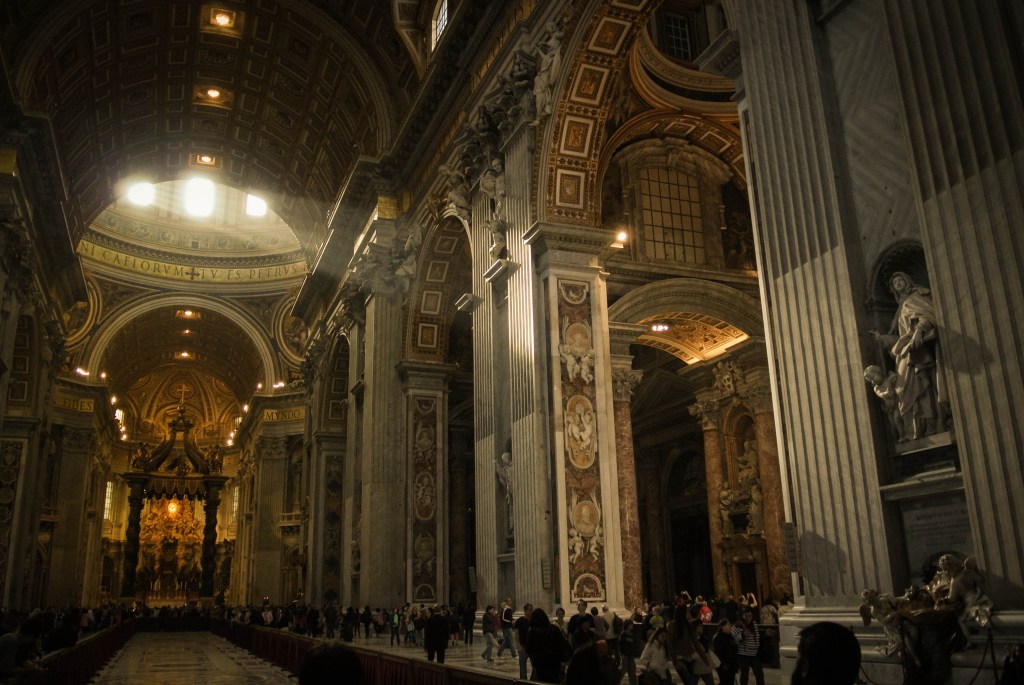
Entry is free, and once inside you can take all the photos you want, as long as you don’t use flash. The exception being the Sistine Chapel, which you may not photograph or record at all. This is to help preserve the painting, so it’s worth taking note of the rule.
You should also be aware that this is an active place of worship. Masses are held all the time in the Cattedra and the Left Transept, so try to give those attending mass their space. You don’t want to be forever known as the person who got excommunicated for stepping on a cardinal’s robes while you were trying to get a selfie with Jesus.
On that note, while I do recommend giving yourself time to explore on your own, you should also definitely get a tour of the place because there is so much to learn, and any tour will barely scratch the surface of that knowledge. The history of the catholic church is a sordid one, full of secrets, scandals, and desecration. From the censoring pope who had every nude figure covered, to the incredible pettiness of one pope’s burial of another, the Vatican is as rife with political intrigue as it is with religious fervor. I could probably fill a whole blog with it’s history and I don’t know all that much of it myself!

During your visit you may also see some men in colorful outfits with poofy pants. Those are members of the Swiss Guard. They, like the Queens Guard in England, follow what seems to be a tradition of dressing deadly individuals in silly outfits. They are there to protect the Pope, and while the ones in renaissance dress may not be carrying guns at any given time, the ones wandering around in modern dress are armed. Leave all of them well alone.
Other than that, the Vatican is supposed to be a place of peace and a welcoming space for all, so even if you’re of a different faith or no faith at all, don’t be afraid to go in and have a wander. It’s really and truly worth it!
Are there any places of worship you particularly like to visit? Leave a comment below!
 Lostman's Star